
About cancer, lifestyle, and what we’d rather not hear — but what is worth knowing.
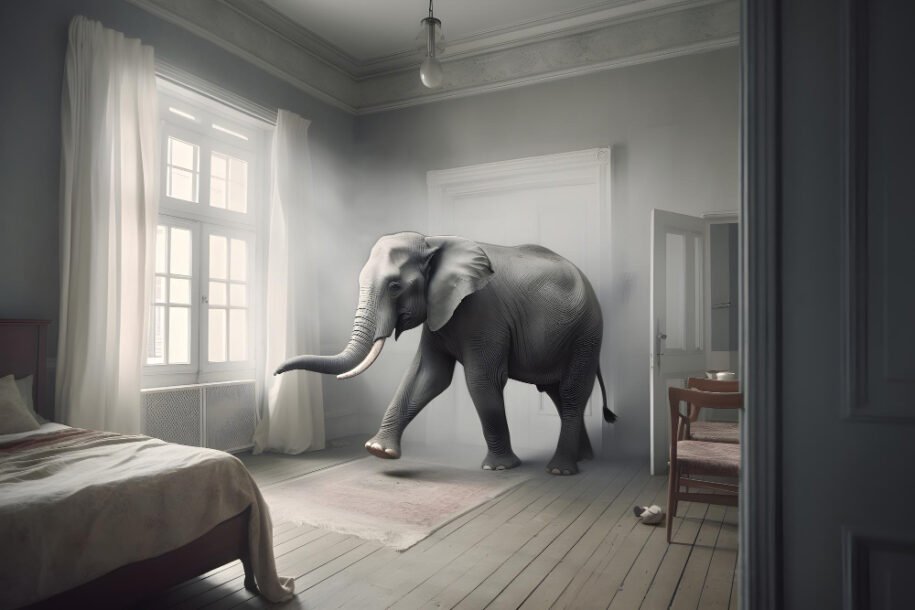
Preliminary note: “the elephant in the room” is an English expression for something that everyone sees, everyone feels, but that no one wants to talk about. The beast stands right in the middle of the room, but out of politeness, discomfort, or unwillingness, we collectively look around it. That is what this blog means. Nothing more, nothing less. And certainly not a reference to weight or body shape — that is completely irrelevant here.
There are subjects you don't just bring up. Not at the kitchen table, not at birthday parties, and to be honest, not always in the doctor's consulting room either. Cancer is one such subject. The word alone feels heavy. And understandably so — because cancer touches everyone somewhere, one way or another.
But there is something that we, as a society, have collectively been looking away from for years. Not out of ignorance. Rather because it is uncomfortable. Because it touches upon habits we cherish. On choices that are our own.
And that is exactly why it is worth bringing it up.
What science says
In early 2026, the World Health Organization (WHO) and its research institute IARC published one of the most comprehensive cancer analyses ever. Data from 185 countries, 36 types of cancer, and an accurate calculation of 30 risk factors.
The conclusion: nearly 40% of all new cancer cases worldwide can be traced back to factors that we ourselves can influence.
That is no small claim. That amounts to 7.1 million people per year, a large proportion of whom — in theory — could have gone in a different direction.
The researchers themselves add something remarkable: this figure is likely an underestimate. Some diet-related factors could not be included because the evidence for them is not yet complete enough worldwide. The actual percentage is therefore possibly even higher.
The Big Three
If you look at what carries the most weight among those 30 risk factors, there are three that stand out:
Smoking ranks number one. Responsible for 151 TP3T of all new cancer cases worldwide. Not surprising — but the scale remains impressive.
Infections They come in at two, accounting for about 10%. Think of HPV (cervical cancer), hepatitis B and C, and the H. pylori bacterium (stomach cancer). Many of these infections can be prevented through vaccination or treated if detected early.
Alcohol ranks third, with about 3% of all cases. More modest in percentage, but not in impact — because alcohol increases the risk of multiple types of cancer simultaneously, and that link has been unequivocally established in the scientific literature.
What else is on the list
In addition to the big three, there are risk factors that receive less media attention but do indeed contribute in a measurable way:
Overweight. Insufficient physical activity. Air pollution. Exposure to UV radiation. Certain substances in the workplace.
And then — for those reading this as women — there is something that stands out. In women, infections are the greatest preventable risk factor (11%), followed by smoking (6%) and being overweight (3%). That third point — being overweight as a risk factor for cancer — is something that surprises many people. We know being overweight as a risk factor for cardiovascular disease and diabetes. But cancer? That link is less well known and underemphasized.


No little fingers
This is the point where this story takes a different turn than you might expect.
Because this is not a call to feel guilty. Not about your smoking history, not about your drinking at parties, not about the extra kilos you have gained over the past few years. That helps no one, and it is not the purpose of the research either.
What the research does show is that lifestyle matters. Not as a moral issue, but as a measurable reality. And that strikes a different tone.
Guilt is paralyzing. Knowledge is liberating — if you can do something with it.
What you *can* do with it
The beauty of this type of research is that it also offers hope. Because if nearly 40% of the cases are associated with modifiable factors, then there is room. Not for perfection. But for movement.
Quitting smoking has a direct effect on your risk, regardless of your age.
Less alcohol means less risk. This applies even with a moderate reduction.
Exercise more, eat healthier, maintain a healthy weight — they have become clichés precisely because they are so versatile. But they don't become clichés for nothing.
And vaccinations — for HPV, for hepatitis B — are for certain groups a concrete and effective means to reduce the risk of infection-related cancer.
Small steps, stacked over time. No big sacrifices, no radical upheavals. Just: tipping the scales a little bit to the other side.
Finally
Cancer will always remain partly unpredictable. Genetics plays a role. Chance plays a role. Not everything can be controlled, and that is a reality we must accept.
But 40% is not insignificant. That is no needle in a haystack — that is a substantial part of the story that we can write ourselves.
And perhaps that is precisely why it is worth simply calling the elephant in the room by its name every now and then.
Sources: WHO/IARC Global Cancer Burden Analysis 2026, published in Nature Medicine.

About Kitty Atsma
Kitty is a passionate nutrition specialist and vitality coach with a broad scientific basis in nutrition and exercise. As a member of the national examination committee of the TCI (Nutrition Specialist & GWC), she monitors the quality of the field at the highest level. As a professional blogger, Kitty combines her in-depth expertise with the possibilities of AI to make complex health topics accessible. She curates and controls the technology to get to the heart of the matter, where her own vision and years of practical experience always determine the course.
Nutrition Specialist Teacher | BGN Weight Consultant | Member TCI Examination Board | Vitality coach
 English
  Dutch
Dutch